American Geophysical Union (AGU) Wrap Up

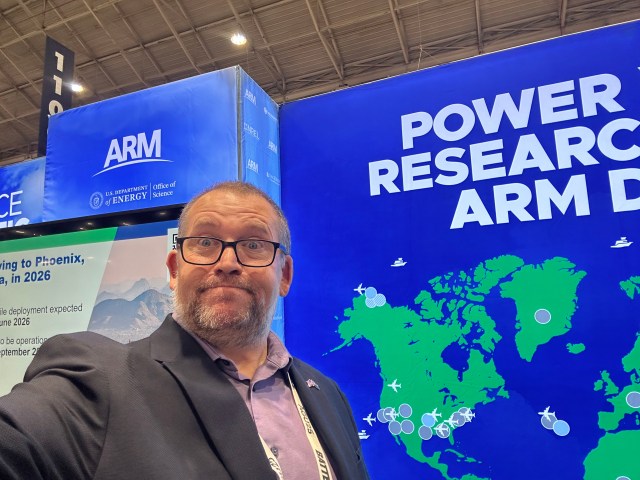
Representing ARM at the booth.

Why do we meet? That is a question I ask all the time. Why do we spend the time, inconvenience, taxpayer’s money to all move our meat sacks to a common location? It is because science is a team sport. From the days of debating at the Royal Society active person to person and person to group communications is vital for the sharing and discussion of ideas. There has been a lot of pushback on our science lately as not being willing to accept criticism and that those involved in the earth sciences are an echo chamber of self reinforcing tropes.

This is why we meet. To present and challenge our beliefs in a respectful way. Also, for those of us who work in large teams, meeting in person can resolve an issue that has lingered for weeks via email in a 30 minute sit down. This could mean 5 trips across the USA or one trip to a societal meeting like AGU.

Representing ARM’s Summer Schools

I had debated the value of going to AGU this year. I had plans to go to the American Meteorological Society (AMS) meeting in Houston as I have a much greater leadership role in the AMS. In the end, due to losing one of our key staff to private industry, being asked to chair a session and a new mission, attached to my interest in Project Genesis I decided it was worth meeting.

First, on project Genesis. Bad data = Bad AI. More and more data is being enabled and collected by private industry. One mission I had this AGU was to understand the increasing roles of startups and established players in the private sector and which entities I should advocate for Argonne to partner with. I met with over 10 potential industry partners and learned about everything from the commercialization of OU drones with iMet to self driving weather balloons from Sorcerer.
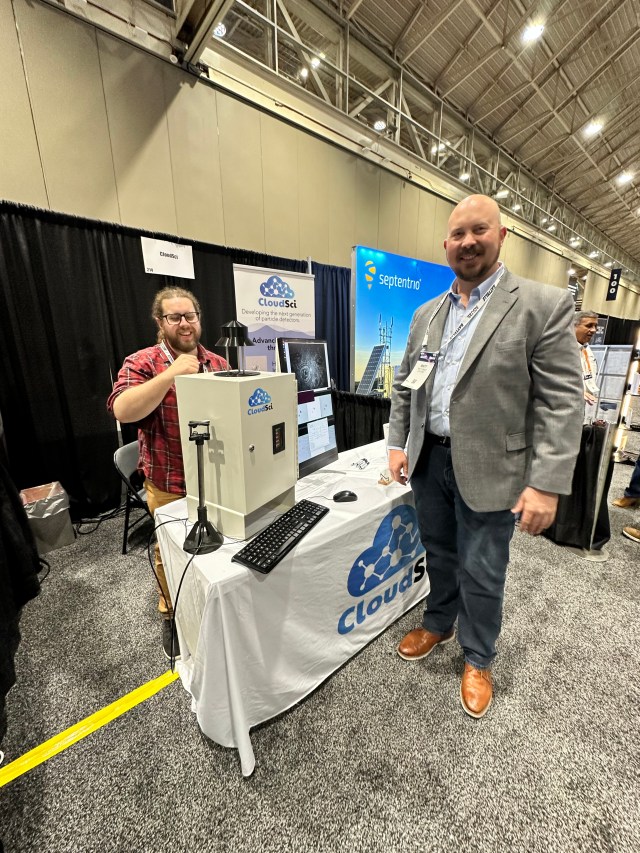
CloudSci at AGU. Some pretty cool tech.

I also had the distinct honor of seeing my ANL Colleague, Jiwen Fan, become an AGU fellow. Why is this a big deal? Science is built on trust. Being named a fellow of a society (AGU, and AMS for example) is the action of that society saying “This person, they have done some great things for science and you should listen to them”. Does this sound elitist? yes. It is by the very definition elitist. But when it comes to trust being elite is important. When I fly I want a top gun pilot, when I am under the knife I want the best surgeon. And when it comes to understanding how aerosols impact clouds, I want to trust the best scientists.

Congratulations Jiwen!

The other big job I had to do was helping to get the good word out about my primary sponsor, the Atmospheric Radiation Measurement Facility (ARM). ARM is user facility of the Department of Energy and is the largest open atmospheric observatory focused on improving simulations of the atmosphere on the planet. In order to make ARM impactful scientists, those who attend AGU, need to know we exist and what we offer. So, like my days, decades ago, selling furniture back in Australia for K-Mart, I was in sales! And the sell was easy: Got Science? We got data! ARM’s mission drew me to the USA and will always be home base. Also, we were letting everyone know we are running the next ARM Summer School on Big Open Data Science! We can’t train the next generation of Energy ready scientists if they don’t know what we are doing.

Now, yes, is New Orleans fun? YES! Is it a perk to travel? Yes… And I acknowledge that privildge. It is both a perk and a pain. A benefit and a cost. To say otherwise will be disingenuous. I love seeing the world and this is my fourth visit to the big easy. I love this southern city. The food, the vibe and, in December, the nice temperature! Conducive to scientific collaboration and good for the soul that has been incased in Chicago cold.

CAPE-k Summer School

Long time, no post. I’ve got to get better at updating this blog. Good news is I have something very nice to post about! We have just finished helping at the Cloud And Precipitation Experiment at kennaook (CAPE-k) Summer School! Max Grover and myself were approached by the Director of the ARM facility with a request to help on a course after he attended the kick off of a deployment of the ARM facility to the kennaook/Cape Grim Baseline Air Pollution Station (KCGBAPS) on the northwestern tip of Tasmania. Note that the lower case k is not a typo as the indigenous peoples of the region do not capitalize place names.

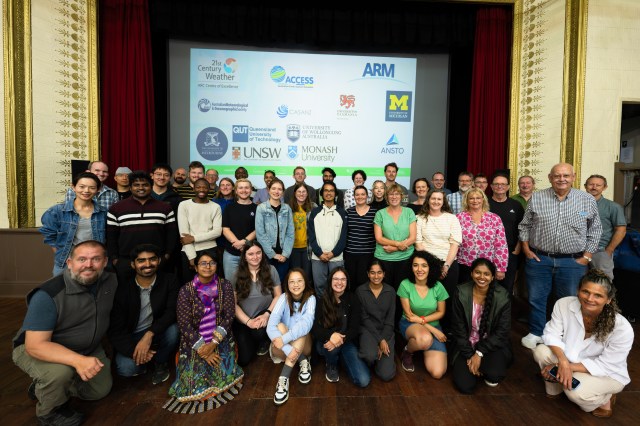
Summer school students, instructors and Cape Grim scientists

Unlike the summer school we ran in Cleveland last year we were not responsible for the overall organization. We came in with the skills and background to run the hackathon hands on coding component. ARM also supported four students, three US based students and a student from Melbourne University. Of course we jumped at the chance to have an international impact in our Education and Outreach Coordination (EOC) efforts. We took the same playbook we developed previously, using the resources of Project Pythia where the students will develop Jupyter cookbooks on a variety of science themes.

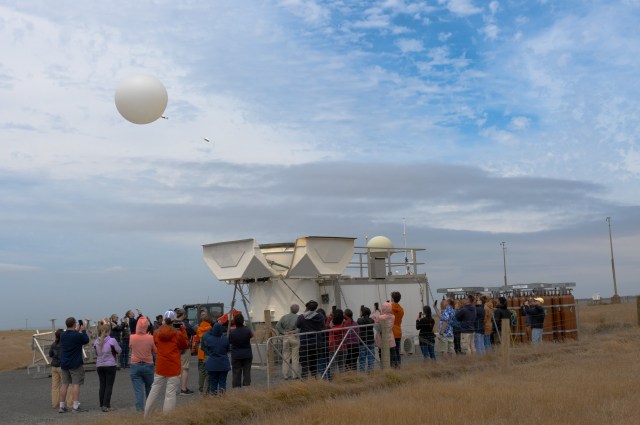
A weather balloon launcher from the BOM/ARM Autosonde collecting KEY data in the southern ocean.

Unlike Cleveland, the school was located close to the ARM deployment allowing a site visit. This was incredible allowing the 27 students (our four and 23 others from Australia and Europe) to see the world class instrumentation at the site. For those that do not know ARM is a Department of Energy, Office of Science user facility. The office of science is the largest federal sponsor of basic research in the physical sciences. Unlike NOAA or NASA ARM focuses on collecting key observations to improve our predictive understanding of our planet. The science advances from ARM benefit everyone from city planners to grid operators. The reason why ARM is in Tasmania is because the southern oceans is one of the most observationally sparse regions on the planet and what happens in the southern ocean impacts the whole globe including the USA.

Four students from the USA and Australia supported by ARM to attend the school. Emily Tomasiuk, Kyndra Buglione, Keyleigh Reilly and Tiantain Zhu.

Our EOC mission is to enhance the impact of ARM data by training the workforce of the future. ARM data is complex, REALLY complex and ARM has developed a suite of open tools like ACT and Py-ART that make it easier for everyone to use our data. This is why Max and I traveled hours (many many hours) downunder to help our friends. We are so lucky to have amazing mentors for the group projects from the University of Wollongong (our fearless leader Clare Murphy), the University of Michigan, the University of Melbourne and Monash University. We also could not have done this without the support of the ARC Center of Excellence for the Weather of the 21st Century, ACCESS-NRI, AMOS and CASANZ. And of course the support of the Australian Bureau of Meteorology (my old employer!) and CSIRO

The team on the site visit to Cape Grim and the CAPE-k ARM deployment.

The student projects were AMAZING. Four projects spanning the gamut of earth science. These students give me hope for our scientific future. The skills these students will bring into our field will mean a more predictable earth system meaning better planning and more lives saved.

Editorial note: These views are my own, Scott Collis, and do not necessarily represent the views of any of the organizations mentioned in this article.

We Bought a Cabin!

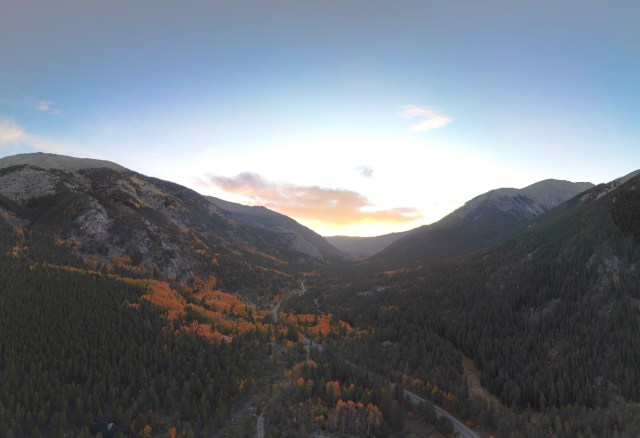
Mount Elbert Massif. Our cabin is in the valley on the left of the image after Twin Lakes.

Super quick update! I have not updated this blog in years. We are the proud owners of 5 acres of land, complete with our own rock outcropping, many pines and aspens, just off Colorado State Highway 82. So grateful to Bob and Lois for not only taking such amazing care of the cabin and land but being so kind and generous during our discussions. It is amazing buying this from a friend. We were NEVER intending to buy. At least not when River is in College (yeah, that happened). But when Bob announced he was selling the property we decided, even if it paupered us, we had to go for it!

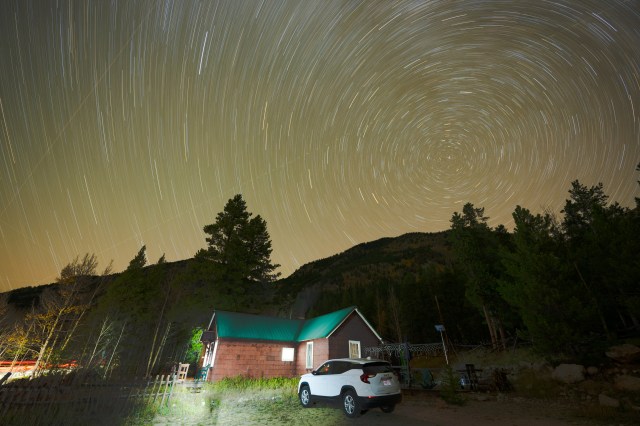
The cabin at night.. Yes its DARK!

The property sits about 1/2 way between Independence Pass and Twin lakes. It is a few miles before the gate that closes the highway in Winter. It sits just above 10,000 feet to the air, while fresh, is rare! We are surrounded by the San-Isabel National Forest which includes the highest mountain in Colorado, Mt Elbert. We can see the ramparts of La Platta and many other 14’ers! We have no real plans from here but to occasionally work remotely and enjoy the mountians. One thing we have done is fully instrument the property so we can remotely monitor. there is no central heating so we “winterize” it every time we leave and I have installed temperature sensors and cameras throughout. And, of course it has a CoCoRAHS rain/snow gauge (CO-LK-34) and Ambient Weather station! https://ambientweather.net/share/5jAVv2

Done panorama taken above the property looking back toward Twin Lakes.

The Future of the Open Programming Symposiums

Started by Johnny Lin, the Python Symposium (Symposium on Advances in Modeling and Analysis Using Python now the Symposium on Advances in Modeling and Analysis Using the Programming Languages of Open Science) has been a home for showing the community of the American Meteorological Society how we do our science. A place to show code and nurture the next generation of contributors in the weather and climate enterprize. I (Scott) took over leadership after the 2017 meeting in Seattle chairing the 2018 meeting in Austin (with an amazing keynote from Matt Rocklin!) . Since then my career has, well, taken off and it is time for new leadership and a reimagining of our symposium. At the 104th annual meeting in Baltimore I announce my plan for the 105th meeting in New Orleans to be the last symposium I lead. I hope to have a cadre of new leaders help me with the 105th meeting. We will be holding a virtual meeting in May to recruit and discuss the future of the symposium. Please sign up and express your interest HERE. This will help us decide the future of leadership for the 106th meeting in Houston and beyond.

Leading the symposium has been a pleasure! Each year after leading it I feel rejuvenated and keen to do it again. It is important to pass on the torch to new generation who can innovate and take our symposium in a new direction.

It’s All In The Detail

This post is the viewpoint of myself, Scott Collis, and does not represent the views of the United States Department of Energy

Dear readers, I have some exciting career news. For the next twelve months I am going to be detailed, at 25% of my time, to the Department of Energy’s Office of Science. I will be reporting to the division director of the Earth and Environmental Systems Sciences division (EESSD).

EESSD logo used in reports and other materials.

While I have not started yet and the full scope will be determined collaboratively with my DOE colleagues, the first projects I will be tackling will be related to the DOE BER Research Development and Partnership Pilot (RDPP) and Reaching a New Energy Sciences Workforce (RENEW) – Earth and Environmental Systems programs. A focus will be on improving access of typically underrepresented groups to the division and generally increasing the presence and visibility of the division to all scientists. So many of us who have been funded by EESSD for many years know the structure of DOE programs and their funded activities can be difficult to navigate and many of us have benefitted from having others help us understand the myriad of opportunities at DOE.

This old model does not lend itself well to increasing the diversity of EESSD science. If we are going to attract the attention of scientists at typically underrepresented institutions (eg HBCUs and MSIs) we must aid in the navigation of EESSD. This will be achieved with improved clarity of language, having clear and welcoming points of contact, round tables and outreach efforts.

In my view, this work is essential as unintentionally limiting (and to labor the point, not by design) EESSDs science teams to well resourced and well connected institutions the Office of Science will not have the diverse workforce it needs that allow diverse ideas to flourish. Who knows? The next great earth scientist who solves big problems like warm rain onset, representing ice bearing clouds in climate models accurately or how the world’s carbon stocks will change in a changing climate may be sitting somewhere at an institution that has yet to engage with DOE.

2022 ARM/ASR Joint User Facility and PI Meeting – Day One

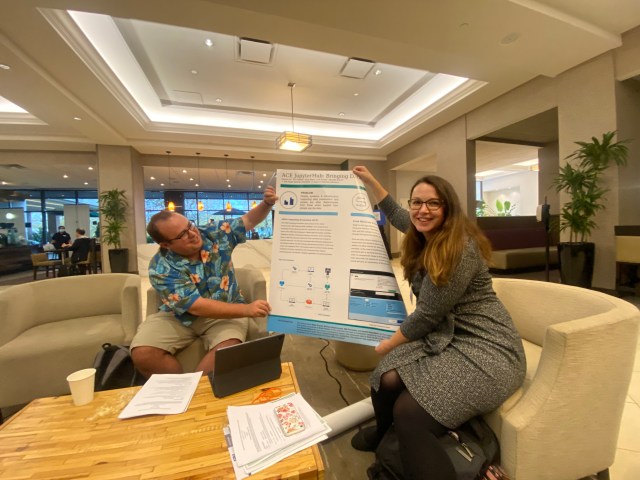
Impromptu poster session with Monica.

Well, kind of day half! Woke bright (dark) and early at 4am for the 7am flight from O’Hare to the nation’s capital. After a smooth travel day I arrived at the very familiar Rockville Hilton with a small posse of Argonne Scientists.

The isolation (albeit easing) through the pandemic changes one’s brain chemistry. I have not been in a place where so many people know me and I know so many people in a very long time. Furthermore there are people here I have developed professional relationships with via zoom during the pandemic and now I meet them here in glorious, high def, lag free, three dimensions!

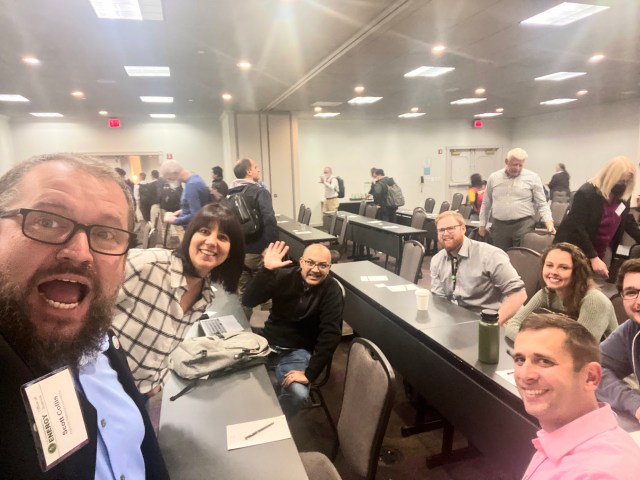
Team Argonne-ARM selfie!

One such person is Dr Monica Ihli from Oak Ridge National Laboratory. Monica was plugged into the ARM Facility after the start of the pandemic and she has been working closely with Max Grover (an RSE in my group) on data proximate compute as part of our funded work in workforce development. She is working with Max to build Jupyterlab based cyberinfrastructure right up against the many petabytes of ARM data. We even had an impromptu poster session! That kind of interaction does not happen over zoom.

Latest results from the TRACER Aerosol team.

This first, half day, of the meeting had two sessions that necessitated an early morning flight. A session on the TRACER field campaign that just finished. And, in a new innovation a session on emerging technologies. The TRACER session provided an awesome overarching view of the 1 and a half year deployment to Houston. Numerous partners, already 38TB of data in the archive and, at this meeting, 32 posters being presented mere days after the conclusion of the deployment! Some notables for me was the different temporal and spatial scales of the aerosol (those tiny particles that have big impacts) measurements and early efforts to classify and tag storms impacting the region.

Finishing the day with hot pot with friends.

The new and emerging technology was fascinating. So many technologies that, if realized, would be amazing. One technology I have my eyes on is the Snow Pixel by Particle Flux Analytics. It is like a digital camera for measuring snowflakes by sensing when a flake falls on them. And that was one of many, I have a page of notes to follow up on, especially for our plans for the CROCUS measurement deployment.

A great first day, finished up with some hot pot with fiends.. I am slowly regrowing that Science-Social nexus in my brain again that has gone un-fed for a long time.

The ARM ASR Science Team Meeting

A note: This represents the view of a DOE funded scientist, not the Department or any of its programs.

Screenshot from a talk I gave at the ARM meeting 13 years ago!

I did not have an iPhone back in 2009 when I attended my very first ARM Science Team meeting in Louisville, Kentucky. So I have been unable to find any pictures of the event. I did find my old presentation I gave! I arrived in Ky after flight from Australia which got delayed and an unexpected stop over in LA. I arrived barely in time to give a talk on vertical motions in storms!

That meeting was in spring (in the USA) and now we are here in fall 13 odd years later and next week will be first in person ARM-ASR science team meeting since the pandemic started in the USA. I used to work for the Australian Bureau of Meteorology and now I live in Chicago and work for Argonne National Laboratory and my work is a lot closer to ARM’s mission.

Real work gets done. ARM ASR science team meeting in Potomac, March 2013.

I am excited to be back at this meeting in person (in Rockville, Maryland). This will be my first “Programmatic” meeting since the Pandemic began. What is a programmatic meeting? you ask. Well funding bodies like programs within the Department of Energy’s Office of Science will provide support to universities, laboratories etc the same way programs in, say, the National Science Foundation will but they are more mission driven. Programs, like the Atmospheric Systems Research, or ASR, program, need those funded by them to work together.

Breakfast to Beer. Science all day. Tyson’s Corner, 2018.

The science ASR seeks to tackle (making our simulations of the planet more accurate and useful for the nation) can not be achieved by any one investigator. ASR forms working groups and special task forces and these groups meet, along with those who manage the programs, imaginatively called… wait for it… Program Managers, meet once a year. These meetings have many purposes but three are: To allow for DOE supported and associated scientists to understand the needs of the programs (ASR and the Atmospheric Radiation Measurement, or ARM program) and closely aligned programs, to allow the program managers listen and gain a deeper understanding of the breadth of science their programs fund and to allow everyone to interact, learn and forge new collaborations.

The last in person ARM ASR Science Team meeting. North Bethesda, June of 2019.

It is an exhausting week. In some years I have had days containing 7am breakfast meetings right up to 8pm science, dinner and a beer meetings. It is the one time all those I work with are in one physical place and it presents unique opportunities. I joke with Louise that it is the only domestic meeting I come back from jetlagged.

The ARM ASR meeting coming up next week is special. It is the first in person meeting in three years and it has been an eventful three years. Much has happened in all our lives, professionally and personally. There will be a lot of catching up. Those who read my blog know of the TRACER field campaign. That has been planned and executed all in this time. I will be heading to the meeting with excitement and an open mind, 13 years after that excited young man traveled to Louisville and his world changed.

Fallen For Fall

Commuting is back!
Great morning for a club ride.

Louise and I were having a discussion about seasons, economics and.. well.. humanity. I am so lucky to be with someone who is so deeply cerebral and who’s proclivities (going deep and philosophical on a subject) match my own.

I posit Australians who have never experienced boreal fall don’t understand just how seasonal and how much Americans revel in seasonality. We were discussing how the fleeting nature and rarity of spring and fall have spawned many celebrations of its passing. While the depths of winter can seem interminable (but not without its special beauty) and the dog days of summer are long, fall and spring seem fleeting and folks seem keen to soak it up.

Spring and fall are also very colorful. The monochrome of winter giving way to the blues, pinks and purples of spring and the green of summer giving way to the flames of fall (Autumn for those of the Commonwealth). The district change in the weather is also a cause for celebration. The first sweet warmth in March and a crisp morning in October.

On fire!

Strangely due to some work and mental health issues, fall to spring are my peak training times. Cycling makes me happy and being happy makes me cycle. I get busy in summer and forget the love of the bike. Come fall I start thinking to spring races and get my behind into gear. I then curse myself for wasting away the warm 5am starts as I shiver in sub-freezing conditions before work (or wimp out and head to the pain cave to Zwift). Ironically fall is my rebirth, perhaps the reason why it holds a special place in my heart.

This year I am targeting an earlier ride than Barry so I am going to ramp up on the Forge Fat Bike race. So the training has started! Well and truly fallen for fall!

CROCUS Academic Partners and Chicago Field Campaigns

The Community Research on Climate and Urban Science (CROCUS) project has twelve (!) academic partners: Chicago State University, City Colleges of Chicago, North Carolina A&T State University, Northeastern Illinois University, Northwestern University, University of Chicago, University of Illinois Chicago, University of Illinois at Urbana Champaign, University of Notre Dame, University of Texas – Austin, University of Wisconsin – Madison and Washington University in St. Louis.

These partners play a wide range of roles from education and outreach to modeling and, what I will discuss here, bringing state of the art atmospheric observatories to Chicago. I will go into more depth on the CROCUS Measurement Strategy (CMS) later (yes I am kind of doing this backwards). There are two key components: the Chicago Micronet and the CROCUS Comprehensive Field Campaign Strategy (CFCS).

The C-Band On Wheels (COW) radar is part of the UIUC FARM. And it is coming to Chicago!!! Courtesy Stephen Nesbitt.

All partners will play a role in the CFCS. As said in the previous post, CROCUS is inclusive and open. But three partners play an outsized role. Over the course of the five years of the project the University of Illinois at Urbana Champaign, the University of Wisconsin – Madison and Washington University in St. Louis will be deploying unique atmospheric observational tools in and around Chicago.

Washington University in St. Louis will be deploying state of the art instruments that can detect and analyze the chemistry of tiny particles called aerosols. They will be able to see how these aerosols grow and interact with the urban environment.

The University of Wisconsin – Madison will be brining a systems taylor made to measure how the city interacts with the larger atmosphere. The University of Wisconsin–Madison Space Science and Engineering Center Portable Atmospheric Research Center (SPARC) has some of the best instruments available for measuring how temperature, moisture and winds change with height. This gives our modeling teams what we call “The column”. That is the layer cake of air above the city. This will help us understand how the regional climate influences Chicago and how Chicago influences the climate.

The SPARC trailer. This facility will tell us what is happening in the skies above Chicago. Courtesy Tim Wagner

Finally, The University of Illinois at Urbana Champaign is bringing the Flexible Array of Radars and Mesonets (FARM). This includes the world famous Doppler On Wheels radars which CROCUS will use to get a neighbourhood scale picture of storms that lead to the worst flooding. The current radar networks around Chicago do not adequately capture the spatial resolution of rainfall important to urban flooding the FARM will allow us to zoom in like a microscope to the street level.

All three facilities will address science as identified by our community partners, Blacks in Green, The Puerto Rican Agenda, The Metropolitan Mayors Caucus and the Greater Chatham Initiative. And they will provide unprecedented opportunities for students. Stay tuned! We are a big tent and this is just the start. We also plan to submit a proposal for the ARM Mobile Facility as another building block to create the largest study of the urban environment, ever.

Community Research on Climate and Urban Science

The day has finally come! As is usual with projects funded by the government we find out many weeks ahead we have been funded and are under embargo as the details are sorted out. Let me start by saying to my fellow scientists who were not awarded: I feel your pain. It is unpleasant, to say the least, to work so hard on a vision and be told you can not carry it out (yet).

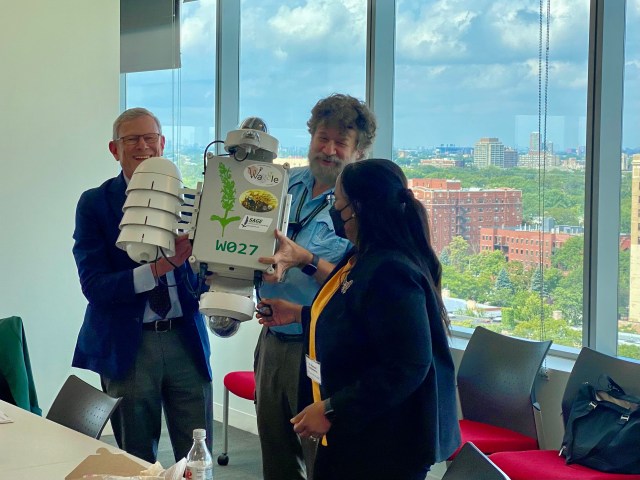
Charlie Catlett showing a Sage node to Dr Berhe, Director of the Office of Science with Paul Kearns, Director of Argonne National Laboratory.

Community Research on Climate and Urban Science or CROCUS is an Argonne led response to a call for proposals by DoE’s Office of Science. In a nutshell; through modeling and measurements, we will shine a light on climate relevant atmospheric science at the street level IN CHICAGO!

I will be leading the Measurement Strategy Team. We will be doing two very exciting things: Building a network of AI enabled sensors across Chicagoland. This is the Chicago Micronet. And we will be running a series (three) of field campaigns aimed at understanding the urban science behind the three climate elements that impact the people of Chicago: Heat, Water and Air Quality.

Bad air is a result of industry transport and energy, water moves and often where we tell it to through urban hydrological systems and heat KILLS. Heat kills more than tornadoes and is the nation’s most deadly weather phenomena.

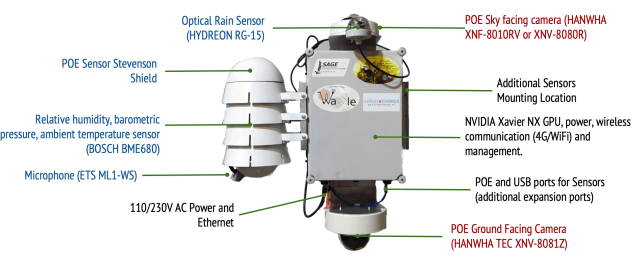
Waggle: The cyberinfrastructure that will enable CROCUS!

For the field campaigns (and I almost giggle with excitement) we have partnered with the University of Washington at St Louis, a leader in understanding the science of aerosols (tiny particles, one millionth of a meter across). The University of Wisconsin–Madison Space Science and Engineering Center and their Portable Atmospheric Research Center (SPARC). And The University of Illinois at Urbana-Champaign Flexible Array of Radars and Mesonets (FARM) which includes the famous Doppler on Wheels (DOW)!

This will culminate in the largest, most inclusive, most open, and, most comprehensive study of an urban environment ever on the planet!

Stay tuned for more news including how we will work with partners like Blacks In Green. To our friend in the community who did not fare as well: I feel for you. But, I am personally dedicated to make CROCUS open and welcoming. Come to Chicago, collaborate with us and we will have so much fun equipping the communities in Chicago with the knowledge they need to fight and prepare for climate change.